
Gilbert Fruhwirth, PhD, MRSC, FHEA

Gilbert Fruhwirth, PhD, MRSC, FHEA, Dipl.Ing.
Professor of Molecular Imaging
King’s College London
Talk Title: “After 25 Years of Imaging Gene- and Cell-based Therapies: Where Are We Now”
The advancement of cell and gene therapies has transformed medicine in recent years providing potentially curative treatments for several complex diseases. At variance to small molecule and protein-based therapeutics, these new treatment modalities unlock hitherto unseen potential but present with several additional challenges after administration. These include their in vivo distribution, the challenge of determining their in vivo activities, and in the case of cell-based therapeutics their potential to expand, to relocate to unintended tissues, and uncertainties relating to their in vivo fate. I will use illustrative examples to give an overview of how molecular imaging has been exploited to address these challenges, what has been achieved, and what we can expect in the near- to medium-term future.
Gilbert Fruhwirth is Professor of Molecular Imaging in the School of Cancer and Pharmaceutical Sciences at King’s College London where he leads the Imaging Therapies and Cancer group. He assumes responsibility as Education Lead for Cancer, is further affiliated with the School of Bioscience Education, and serves as Associate Editor for Molecular Therapy.
Gilbert Fruhwirth studied Technical Chemistry with a focus on Biotechnology at Graz University of Technology, where he also completed his PhD in Biochemistry under the auspices of Prof Hermetter. In 2006, he joined The Richard Dimbleby Department of Cancer Studies led by Prof Tony Ng at King’s College London’s Randall Division of Cellular and Molecular Bioscience, where he studied protein-protein interactions important for cell migration while developing optical imaging tools to observe cancer spread. In 2013, he established his own research group at King’s College London’s Division of Imaging Sciences and Biomedical Engineering, focusing on the development of multimodal molecular imaging toolboxes dedicated to the in vivo tracking of diverse cell types. He holds long-standing expertise in advanced cell tracking in the cancer, immune, and stem cell arenas including methodologies suitable for clinical translation. Gilbert Fruhwirth received Tenure in 2016, was promoted to Senior Lecturer in 2018 and further to Reader in 2022 after joining the School of Cancer and Pharmaceutical Sciences. In 2025, he was appointed as Professor of Molecular Imaging.
His research vision is exploiting multi-modal multi-scale imaging to advance the understanding of cancer and to boost the development and clinical translation of advanced therapies in oncology and immune medicine.
84 peer-reviewed publications incl. 3 book chapters, h-index 38, citations ≥ 4770 (Google 01/2026)
46 invited lectures and international oral presentations. ORCID: 0000-0002-1438-2674.
- Saleem A, Peng Q, Tang Z, Mohseni YR, Scottà C, Shangaris P, Smit K, Vermeij WP, Issa F, Lombardi G, Fruhwirth GO. CAR-mediated release of IL-10 increases the function of regulatory T cells: relevance for future clinical application. Mol Ther 2026 (in press).
- Ashmore-Harris C, Ayabe H, Yoshizawa E, Arisawa T, Takada Y, Takebe T, Fruhwirth GO. Gene editing enables non-invasive in vivo PET imaging of human induced pluripotent stem cell derived liver bud organoids. Mol Ther Meth Clin Dev 2025; 33(1):101406. https://doi.org/10.1016/j.omtm.2025.101406.
- Maiques O, Fanshawe B, Crosas-Molist E, Rodriguez-Hernandez I, Volpe A, Cantelli G, Boehme L, Orgaz J, Mardakheh F, Sanz-Moreno V, Fruhwirth GO. A preclinical pipeline to evaluate migrastatics as therapeutic agents in metastatic melanoma. Brit J Cancer 2021; 125(5):699-713. https://doi.org/10.1038/s41416-021-01442-6.
- Volpe A, Lang C, Lim L, Man F, Kurtys E, Ashmore-Harris C, Johnson P, Skourti E, de Rosales RTM, Fruhwirth GO. Spatiotemporal PET imaging reveals differences in CAR-T tumour retention in triple-negative breast cancer models. Mol Ther 2020; 28(10):2271-85. https://doi.org/10.1016/j.ymthe.2020.06.028.
- Fruhwirth GO, Diocou S, Blower PJ, Ng T, Mullen GE. A whole-body dual-modality radionuclide-optical strategy for pre-clinical imaging of metastasis and heterogeneous treatment response in different microenvironments. J Nucl Med 2014; 55(4):686-94. https://doi.org/10.2967/jnumed.113.127480.
Salim Si-Mohamed, MD, PhD
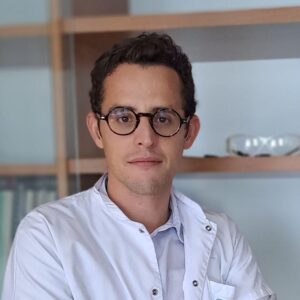
Salim Si-Mohamed, MD, PhD
Full Professor of Radiology, Head of Cardiovascular & Thoracic Imaging Department
University of Lyon, Hospices Civiles de Lyon
Talk Title: “After 50 Years of CT: Where Are We Now?”
In recent decades, computed tomography (CT) has become an indispensable tool in modern medicine, revolutionizing how we diagnose and treat a vast array of medical conditions. CT ability to provide detailed cross-sectional images of the human body has profoundly enhanced the precision, speed, and reliability of medical diagnostics. Today, approximately 375 million CT scans are performed annually worldwide—a number that continues to rise by 3–4% each year. This exponential growth underscores the critical role of CT technology in patient care, from routine diagnostics to life-saving interventions. The global computed tomography (CT) scanners market size is projected to grow from $7.5 billion in 2024 to $12 billion by 2032, at an annual growth of over 6%.
Spectral Dual Energy and Spectral Photon-Counting Computed Tomography (SPCCT) represent the latest frontier in this transformative journey. Building on the foundational principles of CT, Spectral CT offer unprecedented capabilities by harnessing photon counting detectors to differentiate X-ray photons by their energy levels. These innovation enable detailed tissue characterization, precise imaging of contrast agents, and the potential for reducing radiation dose, marking a paradigm shift in diagnostic imaging.
Salim Aymeric Si-Mohamed, MD, PhD, is a full professor in medical imaging at the University Claude Bernard Lyon 1 and head of the Cardiovascular and Thoracic Imaging Department at Louis Pradel Hospital in Lyon. Specializing in diagnostic and interventional imaging for cardiovascular and thoracic diseases, he primarily works with cutting-edge CT technology. Dr. Si-Mohamed’s experimental research focuses on the development of spectral CT technology, including spectral photon-counting CT and dual-energy CT systems, integrated with novel contrast agents for cardiovascular and thoracic applications. He earned his MD in 2016 and completed his PhD in 2020, with his doctoral research dedicated to the cardiovascular applications of spectral photon-counting CT technology. His groundbreaking work demonstrated the feasibility of color K-edge imaging for cardiovascular imaging, particularly in studying atherosclerosis.
Dr. Si-Mohamed is an active member of several national and international research consortia, fostering multidisciplinary collaborations among academic, university, and industry partners. He has authored over 150 publications in leading international journals and conferences, focusing on both experimental and clinical spectral CT imaging. Dr. Si-Mohamed teaches the principles, techniques, and applications of spectral CT, mentoring MSc and PhD students. He is also the holder of an international patent. Recently he was awarded an ERC Starting Grant for the KOLOR SPCCT Imaging Project and an ERC Proof-of-concept Grant for the developement of a KOLOR Viewer, aimed at advancing comprehensive, one-breath-hold imaging of lung diseases using color K-edge imaging and dedicated contrast agents.
–Validation of SPCCT Technology for Assessing Biodistribution of Contrast Agents Based on K-edge Color Imaging: Si-Mohamed S et al. Evaluation of spectral photon counting computed tomography K-edge imaging for the determination of gold nanoparticle biodistribution in vivo. Nanoscale, 2017.
–“First-in-Human” Lung Imaging in SPCCT: Si-Mohamed S et al. Feasibility of lung imaging with a large field-of-view spectral photon-counting CT system. This article was featured in an editorial by Dr. J. Greffier, a medical physicist specializing in spectral imaging.
–First “Proof-of-Concept” of K-edge Macrophagic Color Imaging in a Pre-Clinical Rabbit Atheromatous Model: Si-Mohamed S et al. In Vivo Molecular K-Edge Imaging of Atherosclerotic Plaque Using Photon-counting CT. Radiology, 2021. This article was featured in an editorial by the head of the MRI imaging department at Mayo Clinic, Professor T. Leiner.
–First Global “First-in-Human” Feasibility of Coronary Imaging in SPCCT: Si-Mohamed S et al. Coronary CT Angiography with Photon-counting CT: First-In-Human Results. Radiology, 2022. This article was featured in an editorial by the editor-in-chief, Professor D. Bluemke, and was selected as one of the 5 most important papers in cardiovascular imaging in 2022.
–Development of New Vascular Imaging Combined with a Theranostic Contrast Agent and K-edge Color Imaging: Hernandez et al. (last author: Si-Mohamed S). Color K-edge angiography with a dedicated gadolinium-based contrast agent for spectral photon-counting computed tomography. Diagnostic and Interventional Imaging, 2025. This article was featured in an editorial by Professor David Bluemke, former editor-in-chief of the most prestigious radiology journal and current professor at the University of Wisconsin. This study incorporates elements from the corresponding patent for medical applications dedicated to K-edge color imaging combined with a nanoparticle currently in phase II.
Michael Tweedle, PhD

Michael Tweedle, PhD
Emeritus Stefanie Spielman Professor of Cancer Imaging and Professor of Radiology
The Ohio State University College of Medicine and James Comprehensive Cancer Center
Talk Title: “After 130 Years of Imaging Agents: What Have we Learned and Where are we Headed?”
I will highlight major historical developments in the field of human in vivo imaging agents used in X Ray, Nuclear, MRI, Ultrasound and Optical imaging. It will describe major technical achievements, and some failures, that produced iconic successful variants. Successful imaging agents require industrialization for wide distribution and use. So that we can understand the strengths, roles and limitations of academic and industrial researchers and developers, I will delve into the industrialization, the economics, and the commercialization of the agents. While molecular imaging spans half of the 130 years of imaging agents, by the standards of past development timelines, this newest age is really just getting started and will probably outpace all of the prior ages.
Michael F. Tweedle, PhD is Emeritus Stefanie Spielman Professor of Cancer Imaging and Professor of Radiology at The Ohio State University College of Medicine and James Comprehensive Cancer Center. His education was at Knox College (BA Chemistry), Rice University (PhD Physical Chemistry) and Stanford University (NIH Research Service Fellow). His experience in diagnostic imaging began as a research scientist at New England Nuclear, Inc. In 1981 he invented the first catalyst for production of Tc radiopharmaceutical myocardial perfusion agents, and early targeted molecular imaging (MI) agents using monoclonal antibodies at NEN/DuPont Pharmaceuticals. In 1986, working with E.R. Squibb and Sons, he invented and developed the first novel macrocyclic GBCA (Gd-based MRI Contrast Agent), ProHanceTM (gadoteridol), and the unsymmetrical macrocyle class (used in > 150 million MRI patients and in commercial 177Lu radiotherapeutics). As President, CEO and chief scientist at Bracco Research USA Inc, he and his team created in early 2000s two new clnically tested Molecular Imaging agents: a first in class targeted theranostic for prostate and breast cancer (177LuAMBA), and a first in class sub nM VEGF-R2 angiogenesis receptor-targeting peptide used in the targeted ultrasound contrast agent now in Phase-II clinical trials (BR55). He transiioned toacademics in 2009, focusing research on cancer imaging theranostics and teaching in entrepreneurial development. He is Associate Editor for contrast agents for the journals, Radiology, Magnetic Resonance Imaging and Investigative Radiology, served on NIH study sections in SBIR and Image Guided Therapy, has served on Expert Councils at the US Pharmacopeia, the elected Boards and as Officer of four professional societies, academic Scientific Advisory Boards in molecular Imaging, and on Scientific Advisory and governing Boards of public and private biopharmaceutical and chemical companies, and served on the Dean’s Scientific Advisory Board of New York University’s School of Science. He has authored over 200 publications including 105 peer-reviewed original research papers, 40 issued US patents (8 pending), 13 book chapters, and 40 reviews and editorials, with >10,000 citations and an H-Index of 54. He was awarded The Harry Fischer Medal in 2005, elected a Fellow of the World Molecular Imaging Society in 2023, and elected to the National Academy of Inventors in 2023.
- M.F. Tweedle, J.J. Hagan, K. Kumar, S. Mantha, C.A. Chang “Reaction of Gadolinium Chelates With Endogenously Available Ions” Magn. Reson. Imag. 9, 409-415, 1991. 262 citations
- P.W. Wedeking, K. Kumar, M.F. Tweedle. “Dissociation of Gadolinium-Chelates in Mice: Relationship to Chemical Characteristics” Magn. Reson. Imag. 10, p. 641-648, 1992. 292 citations
- K. Kumar, C.A. Chang, C. Francisconi, D. Dischino, M.F. Malley, J.Z. Gougoutas, M.F. Tweedle. “Synthesis, Stability and Structure of Gadolinium(III) and Yttrium(III) Macrocyclic Poly (amino carboxylates)” Inorg. Chem. 33, 3567-3575, 1994. 326 citations
- M.F. Tweedle, P. Wedeking, K. Kumar. “Biodistributions of Radiolabeled, Formulated Gadopentetate, Gadoteridol, Gadoterate and Gadodiamide in Mice and Rats” Invest. Radiol. 30, 372-380, 1995. 313 citations
- G. W. White, W. A. Gibby; M. F. Tweedle. “Comparison of Gd(DTPA-BMA) (Omniscan) Versus Gd(HP-DO3A) (ProHance) Relative to Gadolinium Retention in Human Bone Tissue by Inductively Coupled Plasma Mass Spectrometry” Invest. Radiol. 2006, 41: 272-278. 430 citations